

 Abhishek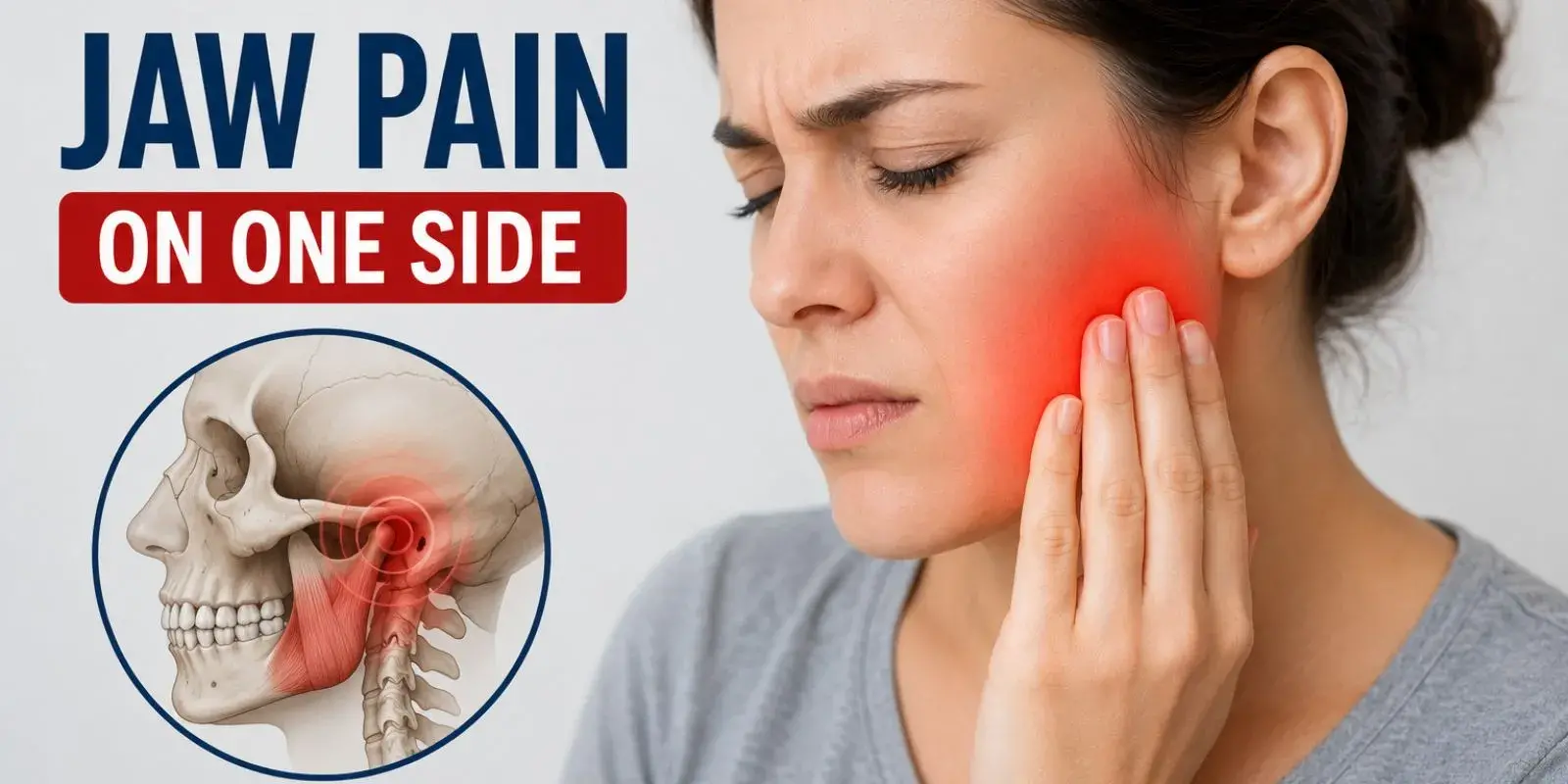
Quick Summary: Why Your Jaw Pain on One Side
Experiencing jaw pain on one side? It can be a confusing and distracting sensation, but understanding the root cause is the first step toward relief. Because the jaw is a complex system involving the temporomandibular joint (TMJ), several muscle groups, and various cranial nerves, the source of the discomfort isn’t always where the pain is felt. While many people immediately assume they have a dental cavity, one-sided jaw pain can actually stem from sinus pressure, stress-related clenching, or even ear infections.
This guide explores the seven most common causes, provides actionable relief steps, and outlines the “red flag” symptoms that require a professional medical or dental evaluation. By understanding the mechanics of your jaw, you can take the first step toward a pain-free life.
The Anatomy of a “One-Sided” Ache
To understand why pain often isolates itself to the left or right side, we first have to look at how the human jaw operates. Your jaw is anchored by the Temporomandibular Joint (TMJ). This joint acts like a sliding hinge, connecting your mandible (lower jaw) to the temporal bone of your skull.
Because we have two of these joints—one on each side—they are supposed to work in perfect symmetry. However, humans are rarely perfectly symmetrical. We tend to chew more on one side, sleep on one side, and even hold our phones against one shoulder more than the other. When this balance is disrupted, inflammation usually flares up in one specific joint or muscle group, leading to that localized, one-sided pain that can range from a dull throb to an electric-like shock.
1- TMJ Disorders (TMD): The Leading Culprit
When the joint and the muscles surrounding it become uncoordinated or inflamed, it is referred to as a TMJ Disorder (TMD). This is the most frequent cause of jaw pain on one side.
- The Disc Displacement: Inside your jaw joint, there is a small, shock-absorbing disc. If this disc slips out of place, it can cause the jaw to “click” or “pop” when you open your mouth. If it slips on the right side, you will feel the pain exclusively there.
- Arthritis of the Jaw: Just like your knees or hips, the jaw joint can suffer from osteoarthritis. As the cartilage wears down on one side, bone-on-bone friction creates a persistent, grinding ache.
- Lockjaw: In severe cases, the joint can become so inflamed that the jaw temporarily “locks” in an open or closed position, usually favoring one side.
Dental Issues: More Than Just Cavities
Your teeth and jaw are inextricably linked. Often, what feels like “jaw pain” is actually “referred pain” from a dental emergency.
- The Hidden Abscess: A dental abscess is a pocket of infection at the root of a tooth. Because the infection creates pressure within the jawbone, the pain can radiate throughout the entire side of your face.
- Impacted Wisdom Teeth: Most people develop wisdom teeth in their late teens or early twenties. If there isn’t enough room, these teeth grow in at an angle, pushing against the jawbone and neighboring teeth. This creates intense localized pressure at the very back of the jawline.
- Malocclusion (Misaligned Bite): If your teeth don’t meet properly when you close your mouth, your jaw muscles have to work overtime to “correct” the bite. This constant muscular strain often leads to a chronic ache on the side that is doing the most work.
You May Read Also: Say Goodbye to Gum Recession: The Ultimate Guide to Treating and Healing Gums
The Impact of Stress: Bruxism and Clenching
In the fast-paced modern world, stress often manifests physically. Bruxism—the medical term for grinding or clenching your teeth—is a leading contributor to jaw pain on one side.
- Sleep Grinding: Many people are unaware that they grind their teeth at night. If you wake up with a headache or jaw pain that fades by noon, you are likely grinding.
- Uneven Force: Most people have a “dominant” side for clenching. Just as a right-handed person is stronger in their right arm, you may put significantly more pressure on your left or right masseter muscle, leading to one-sided exhaustion and pain.
Sinusitis: The “False” Jaw Pain
During allergy season or cold and flu months, sinus infections (sinusitis) become a major cause of jaw discomfort. Your maxillary sinuses are located right behind your cheekbones, directly above your upper teeth.
- Pressure Transfer: When these sinuses fill with fluid and become inflamed, the pressure pushes downward. This can make it feel like your upper jaw and even your teeth are aching, even though your jaw joint is perfectly healthy.
- How to tell: If your jaw pain increases when you lean forward or put your head between your knees, the cause is likely sinus-related rather than dental.
Nerve Issues: Trigeminal Neuralgia
While less common, certain nerve conditions can cause excruciating jaw pain on one side. The Trigeminal Nerve provides sensation to your face.
- The “Suicide Disease”: This is a harsh nickname for Trigeminal Neuralgia because the pain is so intense. It typically feels like a sudden, electric shock or a burning sensation on one side of the jaw.
- Triggers: The pain can be triggered by something as simple as brushing your teeth, applying makeup, or even a light breeze hitting your face. If your pain feels “electric” rather than “aching,” you should consult a neurologist.
Fact-Based Home Relief Strategies
If your pain is not a medical emergency, you can often manage it using these evidence-based methods:
- The “Jaw Rest” Protocol: For 48 to 72 hours, avoid any foods that require heavy chewing. This includes gum, tough meats, raw carrots, and ice. Stick to soft foods like yogurt, mashed avocados, and soups.
- Contrast Therapy: Apply a cold compress to the painful area for 15 minutes to reduce inflammation. Wait an hour, then apply a warm, moist towel to the area to relax the muscles.
- The Tongue Placement Trick: To prevent clenching throughout the day, practice resting your tongue on the roof of your mouth, just behind your front teeth. This naturally keeps your teeth apart and allows the jaw muscles to relax.
- OTC Medication: Non-steroidal anti-inflammatory drugs (NSAIDs) like ibuprofen can help reduce the swelling within the joint.
When to See a Professional
While most jaw pain is benign, you should seek immediate help if you experience:
- Fever and Chills: This suggests a systemic infection from a dental abscess.
- Inability to Open Your Mouth: This could indicate a displaced disc that requires manual realignment by a specialist.
- Referred Pain: If you have jaw pain accompanied by sweating, shortness of breath, or chest pressure, call 911. This can be a sign of a cardiac event, which often presents as jaw pain in women.
Frequently Asked Questions Related to Jaw Pain
Q: Can a COVID-19 or flu infection cause jaw pain?
A: Indirectly, yes. Viral infections often lead to swollen lymph nodes under the jaw and sinus inflammation, both of which can cause a deep ache on one or both sides of the jawline.
Q: Why does my jaw hurt more in the morning?
A: This is a classic sign of nocturnal bruxism (nighttime teeth grinding). The muscles have been under tension for 6–8 hours, leading to lactic acid buildup and soreness upon waking.
Q: Will jaw pain go away on its own?
A: If it is caused by minor muscle strain or a mild sinus cold, it usually resolves within a week. However, if the cause is an impacted tooth or a structural TMJ issue, the pain will likely recur until the underlying issue is treated.
Q: Can an ear infection feel like jaw pain?
A: Yes. The ear canal and the jaw joint are located extremely close to one another. Inflammation in the ear can “migrate” through the nerves, making it difficult to tell if the pain is coming from the ear or the jaw.
Q: What kind of doctor should I see for jaw pain?
A: Start with your dentist. They are the primary experts on the jaw and teeth. If they rule out dental issues, they may refer you to an Ear, Nose, and Throat (ENT) specialist or an Orofacial Pain specialist.
Thank you for reading our guide. We aim to provide clear, actionable health information to help you navigate daily discomfort. If you find this helpful, consider bookmarking our site for more science-backed wellness tips!
About Author