

 Abhishek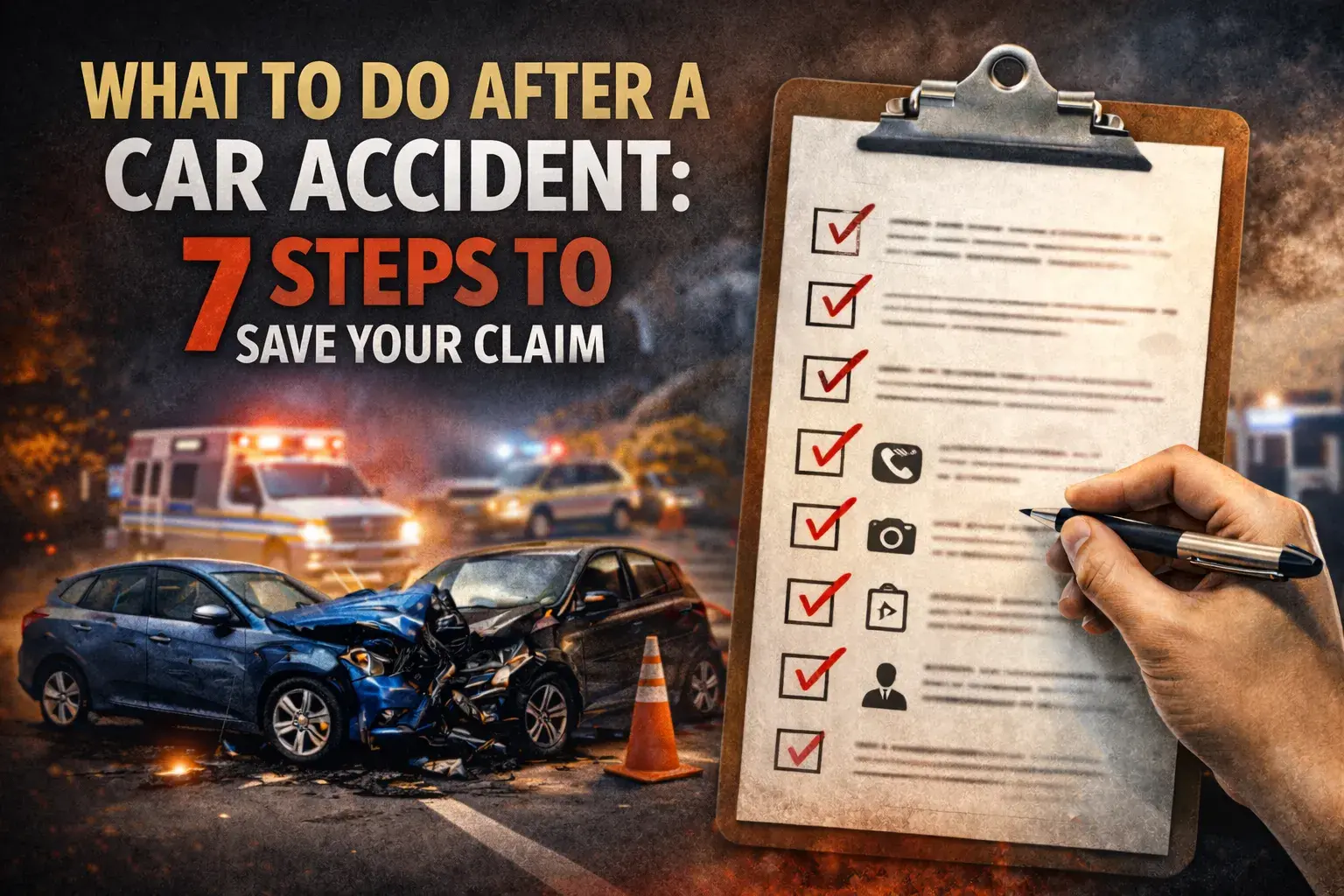
The 30-Second Roadmap
In this roadmap, we explain exactly what to do after a car accident to protect your payout. If you are in a rush, remember these 5 points:
- Safety First: Move to a safe area and check for injuries.
- Call 911: Always get an official police report.
- Document Everything: Take photos of all vehicles and the surrounding scene.
- Never Admit Fault: Avoid saying “I’m sorry” or “It was my bad” if you are not guilty.
- Medical Checkup: See a doctor within 24 hours to protect your health and claim.
A car accident happens in a split second, but the aftermath can last for years. The minutes following a crash are the most critical for your physical safety and your financial future. In 2026, insurance companies use every possible detail to minimize payouts, so knowing exactly what to do after a car accident is your only defense.
Most people panic and make mistakes that “kill” their claim before it even starts. Understanding the legal landscape is the first step toward recovery. For instance, many victims often ask, “Should I get a lawyer for a minor car accident?” (We have broken down when it’s worth hiring a pro even for small fender benders to ensure you aren’t cheated by insurance adjusters).
What to Do After a Car Accident Immediately: Crucial Safety Steps
Step 1: Immediate Safety and Medical Assessment
Panic is natural after a crash, but your first steps determine both your physical safety and your legal standing. In legal terms, every driver has a Duty of Care—a legal obligation to act reasonably and avoid harming others. Understanding what to do after a car accident ensures you fulfill this duty while protecting your rights.
Follow these critical safety steps in one go:
- Hazard Lights: Immediately turn on your hazard lights to alert oncoming traffic and prevent a secondary collision.
- Exit Safely: Only leave your vehicle if you are certain it is safe from passing cars; otherwise, remain inside with your seatbelt fastened.
- Don’t Move if Injured: If you feel severe neck or back pain, stay completely still until paramedics arrive, as moving could worsen a spinal injury.
- Clear the Road: If you are physically able and the vehicle is operable, move it to the shoulder or a safe area to maintain road safety.
- Legal Compliance: Remember that failing to stop after an accident is a crime; staying at the scene is part of your legal responsibility.
Step 2: Call the Authorities (The Power of the Police Report)
Many people panic and forget what to do after a car accident, leading to mistakes that insurance companies exploit. One such mistake is not calling the police. Never let the other driver talk you out of calling the police. A “handshake agreement” will not hold up in court.
- Objective Evidence: The police report is the most unbiased document you can have.
- Traffic Citations: If the officer gives the other driver a ticket, it’s a huge win for your liability case.
Strategic Insight: Documenting for Success
As you wait for the police, start gathering evidence. This is where most people fail because they are in shock. However, failing to collect proof early is one of the critical mistakes people make when hiring a car accident lawyer—they provide the lawyer with nothing to work with. Proper documentation from minute one makes your case bulletproof.
Step 3: Comprehensive Scene Documentation
Use your phone to record everything. In 2026, high-quality video and photos are the standard for insurance adjusters.
- Vehicle Damage: Photos of all angles of all cars involved.
- The Environment: Traffic signs, skid marks, and weather conditions.
- Witness Information: Get names and phone numbers. Their independent testimony is gold.
Step 4: Exchange Information (But Keep it Professional)
Exchange names, license numbers, and insurance details with the other driver.
Crucial Tip: Do not argue about who caused the accident. Anything you say can be used against you by the insurance company later.
Step 5: The “Silent” Documents You Need
While you are at the scene, start a mental (or digital) checklist. You will eventually need a full set of 7 documents for your car accident claim to prove your damages. Having a head start on these documents while the details are fresh in your mind is a massive advantage.
Step 6: Seeking Legal and Medical Help
Even if you feel fine, the adrenaline in your body can hide serious injuries like whiplash or internal bleeding. A medical report dated the day of the accident is your strongest proof for “Pain and Suffering” damages.
At this point, you might realize the situation is getting complicated. If the insurance company is calling you for a recorded statement or offering a “fast settlement,” stop. You need to know the 7 critical questions to ask a car accident lawyer before hiring one. Getting the right legal advice now can mean the difference between a $1,000 and a $50,000 settlement.
Step 7: Filing the Insurance Claim
Once you are safe and have sought medical/legal advice, notify your insurance company. Be factual but brief.
- Stick to the Facts: Tell them where, when, and who was involved.
- Avoid Speculation: If they ask if you are injured, say “I am still seeking medical evaluation” rather than a flat “I’m fine.”
Why the First Hour Matters
Now that you know what to do after a car accident, the actions you take in the first 60 minutes after a crash define the next 60 days of your claim process. By staying calm, documenting the scene, and avoiding common pitfalls, you put yourself in the best position for a full recovery.
If you are still unsure if your situation requires professional intervention, read our comprehensive guide on when you should hire a car accident lawyer. It will help you decide if you can handle it solo or if it’s time to bring in the experts.
What NOT to Do After a Car Accident (Mistakes That Kill Your Claim)
Knowing what to do after a car accident is only half the battle. The other half is knowing what to avoid. Insurance adjusters are trained to look for these exact mistakes, and even one error can reduce your payout by thousands of dollars.
Mistake 1: Saying “I’m Sorry” at the Scene
This is the most common and most costly mistake. Saying sorry — even out of politeness — can be used as an admission of fault. Stick to exchanging information only. Do not discuss who caused the accident with anyone except the police officer and your attorney.
Mistake 2: Skipping the Doctor
Feeling fine after a crash does not mean you are fine. Whiplash, concussions, and soft tissue injuries can take 24 to 72 hours to fully appear. If you skip the doctor and symptoms show up later, the insurance company will argue your injuries are unrelated to the accident. A medical report dated the same day as the crash is one of the most powerful documents in your claim.
Mistake 3: Posting on Social Media
Anything you post publicly after an accident can be used against you. A single photo of you smiling at a family dinner can be used to argue your injuries are not serious. Set all your accounts to private immediately and avoid posting anything until your claim is fully settled.
Mistake 4: Accepting the First Settlement Offer
Insurance companies routinely make low initial offers hoping you will accept before understanding your full damages. Once you sign a settlement release, your case is permanently closed — even if your injuries worsen or new medical costs arise. Never accept any offer without knowing your total medical bills and recovery timeline.
Mistake 5: Giving a Recorded Statement Without Legal Advice
The other driver’s insurance company may call within hours asking for a recorded statement. You are not legally required to give one. Politely decline until you have spoken with your own insurance company or a personal injury attorney. Adjusters are trained interviewers who ask questions designed to minimize your claim.
How Long Do You Have to File a Car Accident Claim? (State-by-State)
One of the most overlooked aspects of knowing what to do after a car accident is understanding your legal deadlines. Every state has a statute of limitations — a deadline by which you must file a lawsuit if you cannot settle with the insurance company.
Missing this deadline permanently eliminates your right to compensation, no matter how strong your case is. Here are the deadlines for the most populated US states:
| State | Statute of Limitations |
|---|---|
| California | 2 years from accident date |
| Texas | 2 years from accident date |
| Florida | 2 years (changed from 4 years in 2023) |
| New York | 3 years from accident date |
| Illinois | 2 years from accident date |
| Pennsylvania | 2 years from accident date |
| Ohio | 2 years from accident date |
| Georgia | 2 years from accident date |
Important: Insurance claims should be reported much sooner — most policies require notification within 24 to 72 hours of the accident. The statute of limitations applies specifically to filing a formal lawsuit, not the insurance claim itself.
If you are unsure about your state’s specific deadline, consulting a personal injury attorney during a free consultation is the safest approach. Most attorneys offer free initial consultations and can tell you exactly where you stand within 30 minutes.
What Compensation Can You Actually Claim?
Many accident victims leave money on the table because they do not know the full scope of what they can claim. Understanding what to do after a car accident includes knowing every type of compensation available to you.
Economic Damages — these are concrete, calculable losses:
- All medical bills, including emergency room visits, surgery, and follow-up treatment
- Future medical costs if your injuries require ongoing care
- Lost wages for every day of work you missed during recovery
- Property damage to your vehicle and any personal items inside
- Rental car costs while your vehicle is being repaired
Non-Economic Damages — these are real but harder to calculate:
- Pain and suffering — the physical discomfort and emotional distress caused by the accident
- Loss of enjoyment of life if your injuries prevent you from activities you previously enjoyed
- Emotional distress, anxiety, and PTSD related to the crash
Punitive Damages — these are rare and only apply when the at-fault driver acted recklessly or intentionally, such as in drunk driving cases. Courts award these to punish the wrongdoer, and they can significantly increase your total settlement.
To understand what a fair settlement looks like for your specific situation, read our detailed breakdown of how much a car accident settlement is worth in 2026.
FAQs Related to What to Do After a Car Accident
Q1: What is the very first thing I should do after a car accident?
Ans: The absolute first step is to check for injuries and move to a safe location. Once safe, call 911 to ensure a police officer documents the scene, which is vital for your insurance claim.
Q2: How long do I have to report a car accident to my insurance?
Ans: Most states and insurance policies require you to report the accident within 24 to 72 hours. Delaying this can give the insurer a reason to deny your payout.
Q3: Can I handle a car accident claim without a lawyer?
Ans: Yes, for minor accidents with no injuries, you can often handle it yourself. However, for major crashes, having professional representation ensures you don’t make mistakes that ruin your claim value.
Q4: What should I do if the other driver has no insurance?
Ans: If the at-fault driver is uninsured, your first step is to file a claim through your own Uninsured Motorist (UM) coverage if you have it. This coverage is specifically designed for this situation and pays for your injuries and damages as if it were the at-fault driver’s insurance. If you do not have UM coverage, you may need to file a lawsuit directly against the driver, though recovery depends on their financial situation. Always consult a personal injury attorney in uninsured driver cases.
Q5: Should I accept a quick settlement from the insurance company?
Ans: No — almost never accept the first offer. Insurance companies make early, low offers hoping you will settle before you understand the full extent of your injuries and damages. Once you sign a settlement release, your case is permanently closed. Wait until your doctor has determined your Maximum Medical Improvement (MMI) — the point at which your condition has stabilized — before considering any settlement offer.
Q6: How do I know if I need a car accident lawyer?
Ans: You should seriously consider hiring a lawyer if any of the following apply: you suffered injuries beyond minor bruising, the other driver is disputing fault, a commercial vehicle or rideshare was involved, the insurance company is offering a very low settlement, or your medical bills exceed $5,000. Most personal injury attorneys work on contingency — meaning you pay nothing unless they win your case. Read our full guide on when to hire a car accident lawyer to help you decide.
Related Articles:
- When Should You Hire a Car Accident Lawyer? (Don’t Make These 5 Mistakes)
- Should I Get a Lawyer for a Minor Car Accident?
- 7 Critical Questions to Ask a Car Accident Lawyer Before Hiring
- 7 Essential Documents You Need for Your Car Accident Claim (2026 Comprehensive Guide)
- Can I Change My Car Accident Lawyer in the Middle of a Case?
- How to Deal with Insurance Adjusters Without a Lawyer: The Ultimate 2026 Guide
- What is an Accident Attorney? Understanding Their Role, Benefits, and Your Rights
- What Happens If I Lose My Car Accident Case? (2026 Guide)
- How Much Is a Car Accident Settlement Amount in 2026?
About Author